
Is 2030 Something Investors Should Fear - or Is It Being Misunderstood?
If you follow financial news, you’ve likely heard repeated concerns about 2030 - often framed around mass retirements, government spending, labor shortages, and national debt.
For high-net-worth individuals and business owners, this steady stream of commentary can quietly create uncertainty. It can lead to hesitation, second-guessing long-term plans, or anxiety about whether current strategies will still hold up in the years ahead. The real challenge isn’t the date itself. It’s navigating uncertainty without clarity or a disciplined strategy.
Why 2030 Has Become a Financial Stress Point
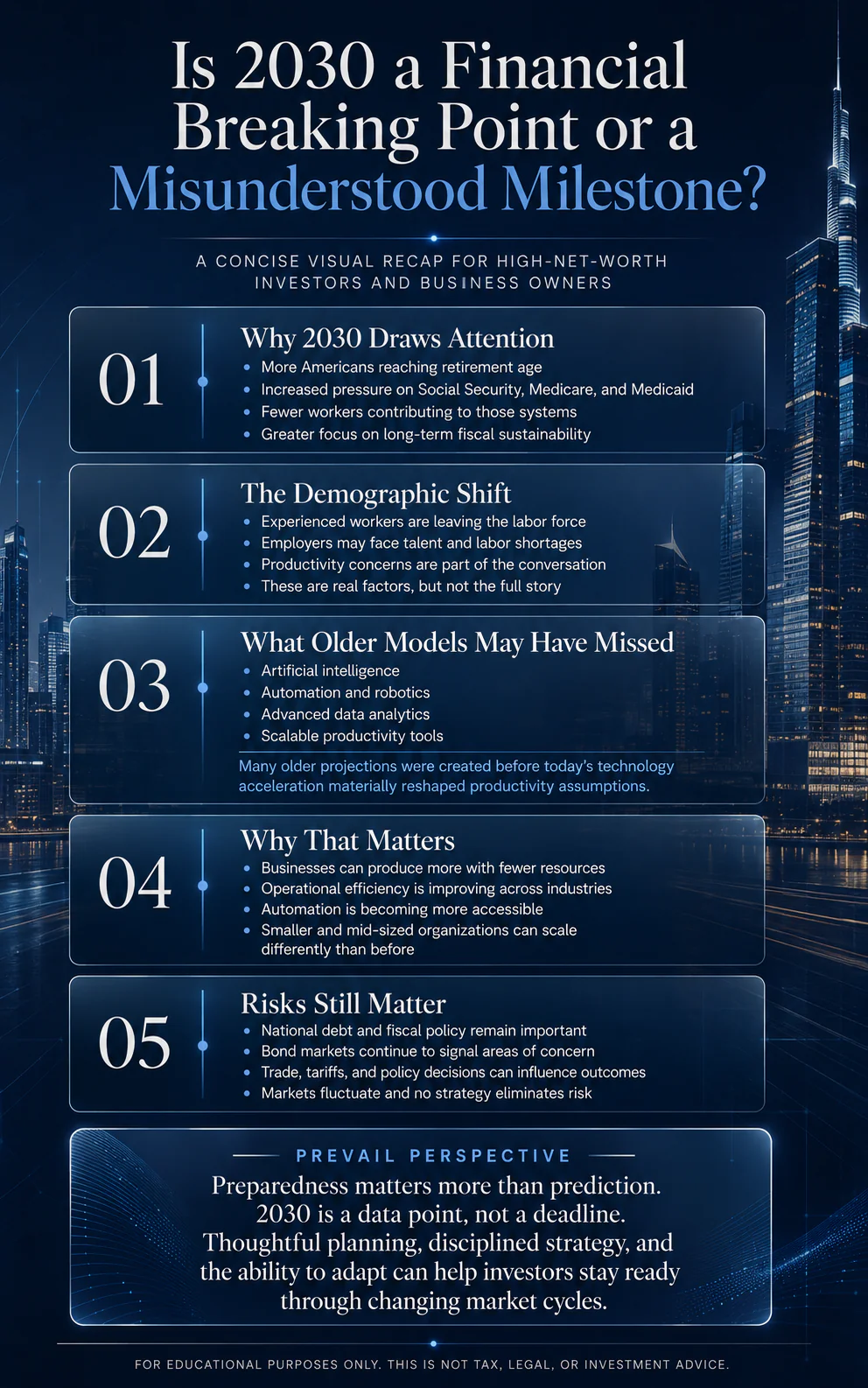
Much of the focus on 2030 is driven by demographics. By that year, the entire baby boomer generation will have reached full retirement age. From a planning standpoint, this creates several widely discussed pressures:
- Increased reliance on Social Security, Medicare, and Medicaid
- Fewer workers contributing to those systems
- A shift in how government resources are allocated
These factors have fueled years of economic modeling that highlight strain and sustainability concerns. When repeated often enough, those projections can feel alarming - especially when they’re discussed without nuance.
The Demographic Shift Driving the Conversation
Beyond entitlement programs, the workforce itself is changing. Large numbers of experienced professionals - many with 30 to 40 years of institutional knowledge - are exiting the labor market. Replacing that experience is not immediate or easy.
Economists frequently point to labor shortages as one of the biggest risks to sustained economic growth. Fewer workers, combined with increased demand for services, naturally raises questions about productivity, wages, and long-term economic output.
These are valid considerations. But they are not the entire picture.
What Early Economic Models Failed to Anticipate
Many of the projections that dominate today’s conversation were created years ago, in a very different economic environment. At the time, they did not fully account for the acceleration of technology that is now reshaping nearly every industry.
In many cases, those models underestimated - or entirely excluded - the impact of:
- Artificial intelligence
- Automation and robotics
- Advanced data analytics
- Scalable productivity tools
As a result, some forecasts paint a picture that no longer reflects how the modern economy actually functions.
Technology, Productivity, and the Changing Economy
Today, productivity gains are occurring at a pace that few anticipated. AI is improving efficiency across sectors, automation is becoming more accessible, and robotics are no longer limited to only the largest organizations.
We’re already seeing:
- Businesses producing more with fewer resources
- Lower costs for automation and robotics
- Greater efficiency across supply chains and operations
- New ways for smaller and mid-sized organizations to scale
These developments matter because productivity directly influences economic growth, labor efficiency, and resilience. While technology does not eliminate challenges, it meaningfully changes the assumptions behind many long-term projections.
Legitimate Risks That Still Deserve Attention
Acknowledging innovation does not mean ignoring risk.
National debt remains a meaningful concern, and bond markets continue to signal areas that warrant careful attention. Policy decisions, global trade dynamics, tariffs, and fiscal discipline all influence long-term outcomes. Economic growth assumptions can shift, and revenue dynamics may not always offset rising expenses.
Investing itself carries inherent risk. Markets fluctuate, economic conditions change, and policy decisions can introduce volatility or disrupt expectations. No strategy can eliminate risk entirely, and outcomes vary based on timing, market conditions, and individual circumstances.
Understanding these realities is essential - not to create fear, but to encourage thoughtful planning.
Preparedness matters more than prediction. A well-structured strategy acknowledges uncertainty and is designed to adapt - when conditions change.
Understanding Risk Without Reacting to Fear
Risk is not something to eliminate; it’s something to manage.
Long-term, diversified strategies can help address volatility and uncertainty, but they cannot guarantee outcomes. What they can do is provide structure, discipline, and flexibility - allowing investors to respond thoughtfully rather than react impulsively.
For high-net-worth individuals and business owners, this perspective is especially important. Significant wealth decisions often carry lasting consequences, making clarity and patience critical.
Staying Ready Through Every Market Cycle
At Prevail Innovative Wealth Strategies, we don’t build plans around doomsday scenarios, nor do we dismiss risk. We focus on helping clients stay ready. Our role is to walk alongside high-net-worth individuals and business owners through every market cycle by:
- Monitoring evolving economic and market trends
- Stress-testing strategies across multiple scenarios
- Adjusting thoughtfully as conditions change
- Keeping wealth aligned with long-term goals and legacy planning
Being prepared does not mean knowing exactly what will happen. It means having a strategy designed to adapt when it does.
2030 Is a Data Point - Not a Deadline
Ultimately, 2030 is not a finish line. It is one point in a much longer economic story. For investors who remain informed, disciplined, and strategically aligned, it does not have to represent fear. In many cases, it represents opportunity - when approached with clarity, preparation, and the right advisory partnership.
If you’d like to better understand how these trends fit into your broader financial picture, our team is here to walk alongside you. At Prevail, we help clients stay ready through every market cycle, so their wealth can continue supporting what matters most.