
Have you ever stopped to ask whether your wealth strategy is designed primarily for your long-term objectives—or for your advisory firm’s ability to scale efficiently?
For many high-net-worth individuals, wealth management begins with good intentions but eventually feels impersonal. Portfolios are often built around standardized models, risk tolerance questionnaires, and broadly diversified funds that look identical across thousands of households. While this approach can simplify operations for large firms, it often leaves sophisticated investors questioning whether their strategy truly reflects their goals, liquidity needs, and desire for control.
This is where many investors begin searching for an alternative—one that prioritizes intentional planning, adaptability, and long-term perspective rather than passive participation.
Why Traditional Buy-and-Hold Often Falls Short
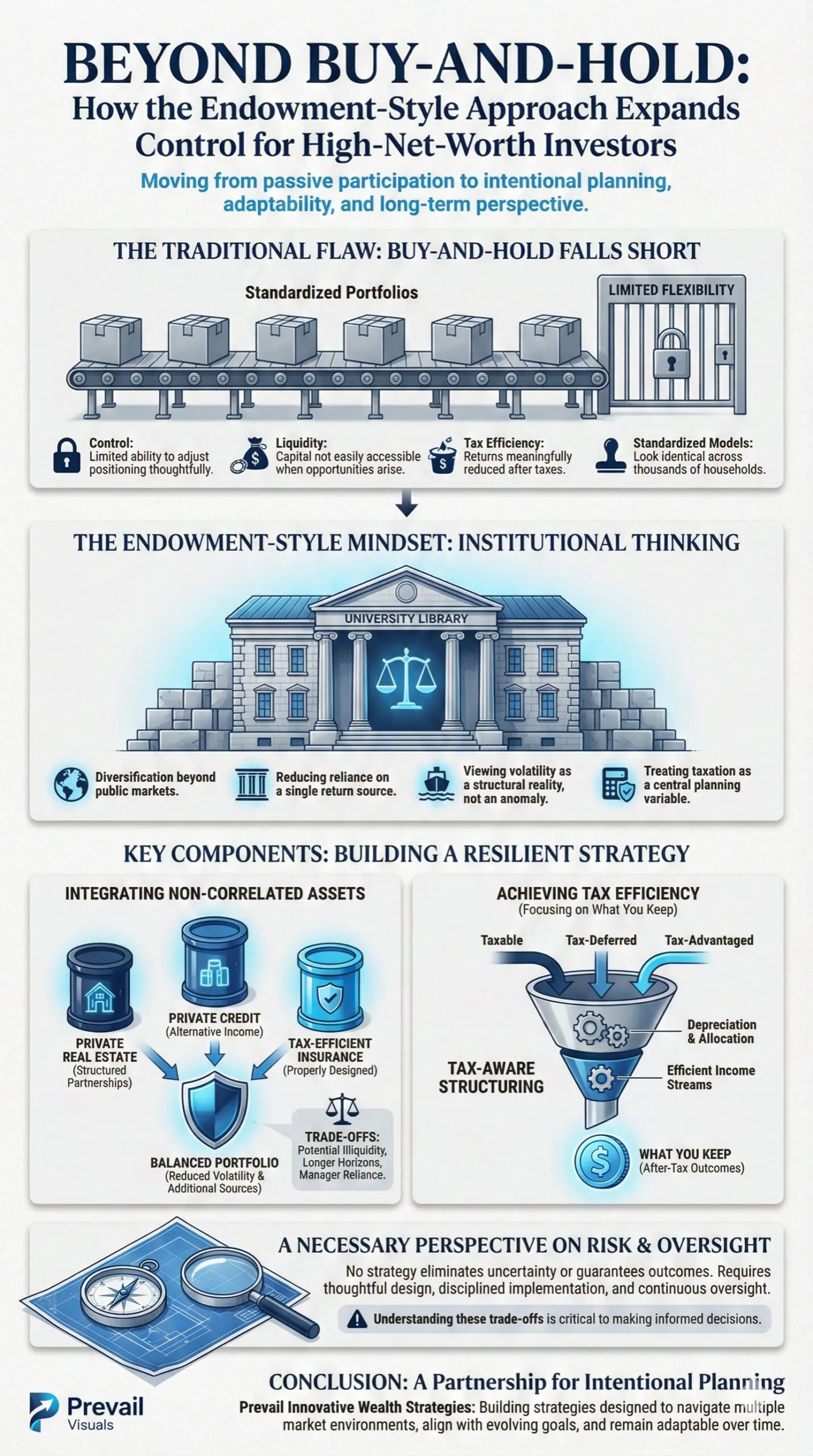
The traditional buy-and-hold model is widely promoted as a long-term solution, yet it is built around assumptions that don’t always align with the realities of high-net-worth planning. Standardized portfolios emphasize broad exposure and minimal oversight, which can limit flexibility during periods of market volatility, legislative change, or personal opportunity.
While buy-and-hold strategies aim to capture long-term market growth, they often overlook three critical considerations for affluent investors:
- Control: Limited ability to adjust positioning thoughtfully as conditions evolve
- Liquidity: Capital that is invested but not easily accessible when opportunities arise
- Tax Efficiency: Returns that appear strong on paper but are meaningfully reduced after taxes
For investors who want a more deliberate and engaged approach, these constraints can become increasingly apparent over time.
The Endowment-Style Mindset: A Different Way to Think About Wealth
Institutional investors such as university endowments, foundations, and pension plans operate with a different mindset. Rather than relying solely on market exposure, they build portfolios designed to function across varying environments. The emphasis is not on predicting markets, but on constructing strategies that can adapt.
An endowment-style approach typically focuses on:
- Diversification beyond public markets
- Reducing reliance on a single return source
- Viewing volatility as a structural reality, not an anomaly
- Treating taxation as a central planning variable
This philosophy doesn’t seek to eliminate risk—because that isn’t possible—but to manage it intentionally through structure and balance.
Comparing Standardized Models vs. Dynamic Endowment-Style Planning
Volatility as a Planning Consideration, Not an Enemy
Market volatility is often framed as something to endure. For long-term investors, however, volatility can also present opportunity when approached with discipline and perspective.
Rather than concentrating solely on broad market exposure, some active strategies incorporate more active oversight, diversified positioning, and incremental decision-making. This can allow portfolios to respond more thoughtfully to changing conditions rather than remaining entirely static.
It’s important to note that active strategies involve their own risks, including timing risk, implementation risk, and increased complexity. The goal is not constant trading, but intentional management aligned with a broader plan.
Tax Efficiency: Focusing on What You Keep, Not Just What You Earn
For high-net-worth investors, taxation is one of the most significant long-term variables affecting outcomes. A strategy that generates returns without considering tax-free strategies treatment may look attractive initially, yet produce materially different results after taxes.
Endowment-style planning integrates tax awareness into asset selection, structure, and timing. This can include:
- Blending taxable, tax-deferred, and tax-advantaged assets
- Utilizing depreciation and expense allocation where appropriate
- Structuring income streams with long-term efficiency in mind
Tax laws are subject to change, and no strategy guarantees future treatment. Ongoing review and coordination with qualified tax professionals are essential.
Risk, Responsibility, and Realistic Expectations
All investing involves risk, including the potential for loss, market volatility, legislative changes, and strategy-specific risks such as illiquidity or manager performance. No investment approach—traditional or alternative—can eliminate uncertainty or guarantee outcomes.
Endowment-style strategies require thoughtful design, disciplined implementation, and continuous oversight. They are not universally appropriate and should be evaluated within the context of individual goals, timelines, and risk tolerance.
Understanding these trade-offs is critical to making informed decisions.
A More Intentional Advisory Relationship
For investors seeking to move beyond standardized solutions, the advisory relationship itself becomes central. A thoughtful strategy requires coordination, education, and a willingness to engage in long-term planning rather than short-term reaction.
At Prevail Innovative Wealth Strategies, our role is to help clients think more intentionally about structure, flexibility, and preparedness. We focus on building strategies designed to navigate multiple market environments, align with evolving goals, and remain adaptable over time.
This approach emphasizes preparation over prediction and partnership over product.
Conclusion: Expanding the Definition of Financial Freedom
True financial freedom is not solely about accumulation. It is about control, clarity, and confidence in how wealth is structured and managed.
By thinking beyond buy-and-hold and exploring an endowment-style framework, high-net-worth investors can gain a deeper understanding of how diversification, tax efficiency, and intentional planning work together. While no strategy removes risk, a well-designed approach can help investors navigate complexity with greater confidence and purpose.
If you’re seeking a broader perspective on how these principles may apply to your situation, consider starting with a conversation focused on structure, not products—and on preparation, not predictions.