

How Much of My Income Should I Be Investing — 2026 Update

Share:

Table of Contents

Table of Contents

Sign Up for Our Newsletter:

Monthly insights from Prevail

8 + 6 =

How Much of My Income Should I Be Investing? A 2026 Financial Readiness Guide

As 2025 comes to a close and 2026 approaches, many people are reevaluating their financial plans. Rising costs, changing markets, and evolving economic conditions make now an ideal time to take a closer look at your savings and investment strategy. This guide breaks down what you need to know in a simple, motivating, and easy-to-read format.
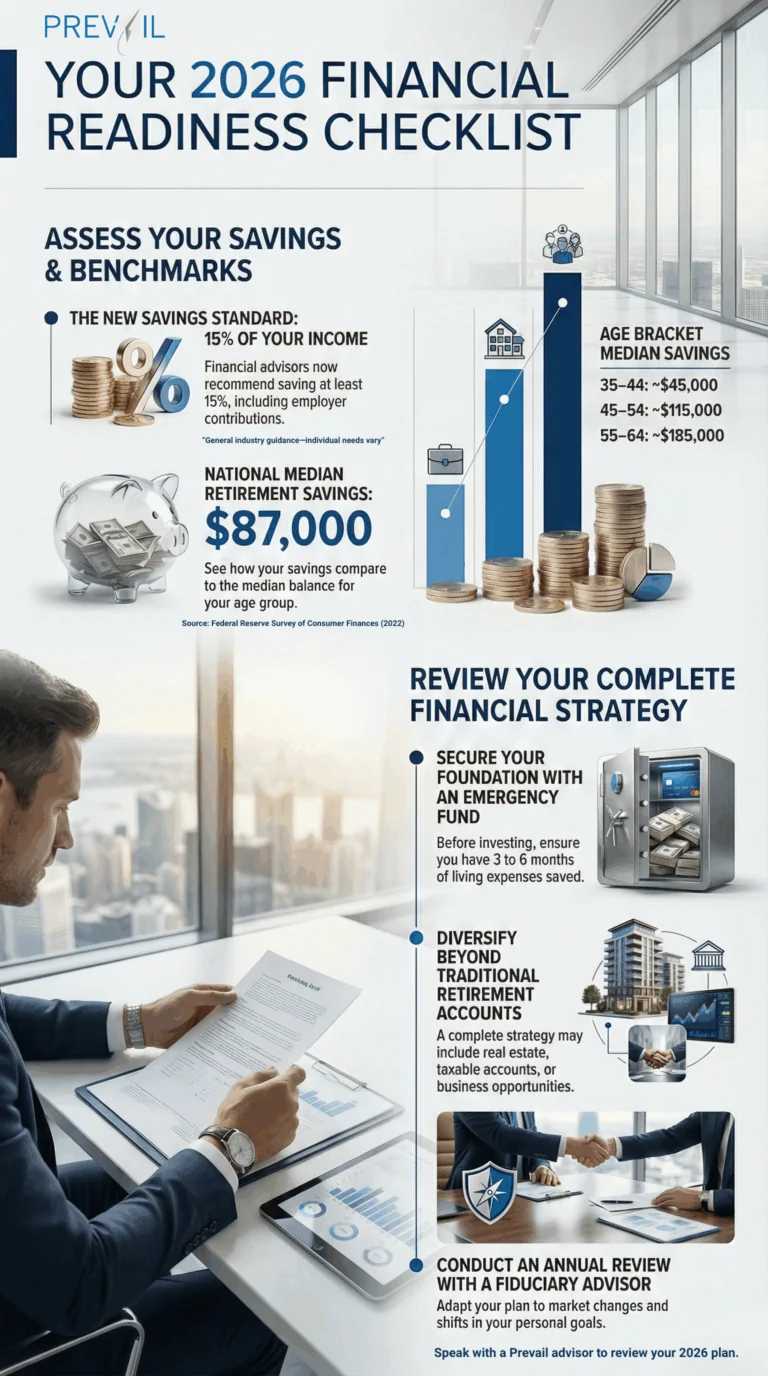
Infographic showing the 2026 Financial Readiness Checklist, including updated savings benchmarks, national median retirement savings of $87,000, age bracket savings, emergency fund guidance, diversification strategies, and working with a fiduciary advisor.


1. How Much Should You Be Saving in 2026?

For many years, financial experts recommended saving 12–15% of your income for retirement. Today, most advisors suggest aiming for at least 15%*, including employer contributions. If you plan to retire early, start later in life, or want a higher level of retirement income, you may need to save more.

Recent surveys show that the median retirement savings balance in the U.S. is about $87,000*. By age, median savings typically look like this:

  • Ages 35–44: around $45,000
  • Ages 45–54: around $115,000
  • Ages 55–64: around $185,000
  • Ages 65–74: around $200,000

These numbers show many people are behind. As you head into 2026, review your savings rate and ask yourself:

  • Am I saving enough for the retirement I want?
  • Does my plan reflect today’s economic realities?
  • Has my income, lifestyle, or retirement age changed?

2. What Should You Be Investing In?

Your investment strategy should reflect your goals, age, and comfort with risk. A fiduciary advisor will often start by asking:

  • When do you want to retire?
  • How much income will you need?
  • What lifestyle do you want in retirement?
  • What other assets or income sources will you have?

Retirement accounts such as 401(k)s, IRAs, and 403(b)s are important, but they are only one piece of a complete financial strategy. Many people today also invest in:

  • Taxable investment accounts
  • Real estate or alternative investments
  • Business or passive-income opportunities
  • Insurance-based planning strategies

As you move into 2026, review whether your investments still support your long-term goals.

3. Do You Have an Emergency Fund?

Before investing more, make sure you have an emergency fund with three to six months of living expenses. This protects you from unexpected financial setbacks and reduces the chances of withdrawing from retirement accounts early.

4. Why Reviewing Your Plan in 2026 Matters

Your financial plan should grow and change as your life does. Before entering 2026, take time to review:

  • Your savings rate
  • Your investment performance
  • Your comfort with risk
  • Any changes in income or expenses
  • Adjustments in your employer plan or benefits

A yearly review helps keep you on track and increases your confidence in your long-term plan.

5. Why Working With a Fiduciary Advisor Helps

The financial world continues to shift. Inflation, global events, and market fluctuations all influence your long-term results. A fiduciary advisor can help you understand how these changes impact your retirement plan and what steps you may want to consider next.

Prevail advisors take a team-based approach to help clients build strong, adaptable strategies that include savings plans, investment strategies, tax considerations, risk management, and long-term retirement planning.

6. Preparing for 2026 and Beyond

Now is an ideal time to review your investment strategy, update your financial goals, and make sure you are saving enough for the lifestyle you want in retirement. With the right guidance, your retirement plan can support a confident, purpose-driven future.

Retirement planning involves uncertainties. Economic conditions, inflation, market performance, and personal circumstances can change over time. Because of this, savings guidelines should be viewed as general frameworks rather than guarantees. Regular reviews with a qualified advisor can help ensure your strategy remains appropriate for your goals and risk tolerance.

Connect with a Prevail advisor to explore your options and discover how you can prepare for a successful 2026.

Phone: 913-295-9500 Email: riseabove@prevailiws.com

*General industry guidance—individual needs vary.

*Source: Federal Reserve Survey of Consumer Finances (2022)

Author picture
Author picture

Kerry Lawing

CEO

Extensive Financial Planning Strategies

Our Team-Based Approach is Comprehensive and Easy.

1

Learn About You

Your Vision
Your Objectives
Your Opportunities
Your Challenges
Your Entire Picture (ie. Business & personal)

2

Develop Custom Strategies

Based on your unique situation
Leverage our team of experts
Establish wealth creation strategies
Determine ideal source of asset transfer

3

Build Wealth

Agree on and implement strategies
Establish tracking tools
Communicate regularly
Ongoing support from your financial BOD (Board of Directors)

How Much of My Income Should I Be Investing — 2026 Update

Professional thumbnail featuring Brad Lawing, CPWA®, CEPA®, AIF®, alongside the title “How Much of My Income Should I Be Investing?” with financial market graphics in the background.

How Much of My Income Should I Be Investing? A 2026 Financial Readiness Guide

As 2025 comes to a close and 2026 approaches, many people are reevaluating their financial plans. Rising costs, changing markets, and evolving economic conditions make now an ideal time to take a closer look at your savings and investment strategy. This guide breaks down what you need to know in a simple, motivating, and easy-to-read format.

Infographic showing the 2026 Financial Readiness Checklist, including updated savings benchmarks, national median retirement savings of $87,000, age bracket savings, emergency fund guidance, diversification strategies, and working with a fiduciary advisor.


1. How Much Should You Be Saving in 2026?

For many years, financial experts recommended saving 12–15% of your income for retirement. Today, most advisors suggest aiming for at least 15%*, including employer contributions. If you plan to retire early, start later in life, or want a higher level of retirement income, you may need to save more.

Recent surveys show that the median retirement savings balance in the U.S. is about $87,000*. By age, median savings typically look like this:

  • Ages 35–44: around $45,000
  • Ages 45–54: around $115,000
  • Ages 55–64: around $185,000
  • Ages 65–74: around $200,000

These numbers show many people are behind. As you head into 2026, review your savings rate and ask yourself:

  • Am I saving enough for the retirement I want?
  • Does my plan reflect today’s economic realities?
  • Has my income, lifestyle, or retirement age changed?

2. What Should You Be Investing In?

Your investment strategy should reflect your goals, age, and comfort with risk. A fiduciary advisor will often start by asking:

  • When do you want to retire?
  • How much income will you need?
  • What lifestyle do you want in retirement?
  • What other assets or income sources will you have?

Retirement accounts such as 401(k)s, IRAs, and 403(b)s are important, but they are only one piece of a complete financial strategy. Many people today also invest in:

  • Taxable investment accounts
  • Real estate or alternative investments
  • Business or passive-income opportunities
  • Insurance-based planning strategies

As you move into 2026, review whether your investments still support your long-term goals.

3. Do You Have an Emergency Fund?

Before investing more, make sure you have an emergency fund with three to six months of living expenses. This protects you from unexpected financial setbacks and reduces the chances of withdrawing from retirement accounts early.

4. Why Reviewing Your Plan in 2026 Matters

Your financial plan should grow and change as your life does. Before entering 2026, take time to review:

  • Your savings rate
  • Your investment performance
  • Your comfort with risk
  • Any changes in income or expenses
  • Adjustments in your employer plan or benefits

A yearly review helps keep you on track and increases your confidence in your long-term plan.

5. Why Working With a Fiduciary Advisor Helps

The financial world continues to shift. Inflation, global events, and market fluctuations all influence your long-term results. A fiduciary advisor can help you understand how these changes impact your retirement plan and what steps you may want to consider next.

Prevail advisors take a team-based approach to help clients build strong, adaptable strategies that include savings plans, investment strategies, tax considerations, risk management, and long-term retirement planning.

6. Preparing for 2026 and Beyond

Now is an ideal time to review your investment strategy, update your financial goals, and make sure you are saving enough for the lifestyle you want in retirement. With the right guidance, your retirement plan can support a confident, purpose-driven future.

Retirement planning involves uncertainties. Economic conditions, inflation, market performance, and personal circumstances can change over time. Because of this, savings guidelines should be viewed as general frameworks rather than guarantees. Regular reviews with a qualified advisor can help ensure your strategy remains appropriate for your goals and risk tolerance.

Connect with a Prevail advisor to explore your options and discover how you can prepare for a successful 2026.

Phone: 913-295-9500 Email: riseabove@prevailiws.com

*General industry guidance—individual needs vary.

*Source: Federal Reserve Survey of Consumer Finances (2022)

Frequently Asked Questions

Lorem ipsum dolor sit amet, consectetur adipiscing elit, sed do eiusmod tempor incididunt ut labore et? dolore?

Quam elementum pulvinar etiam non. Nibh praesent tristique magna sit amet purus. Augue lacus viverra vitae congue eu. Bibendum est ultricies integer quis auctor elit sed. Tortor pretium viverra suspendisse potenti nullam ac tortor. Viverra orci sagittis eu volutpat odio facilisis mauris sit amet. Consectetur a erat nam at lectus urna. Senectus et netus et malesuada fames. Tincidunt arcu non sodales neque sodales ut. Nibh praesent tristique magna sit amet purus gravida quis. Ultrices neque ornare aenean euismod elementum nisi quis. Potenti nullam ac tortor vitae purus faucibus ornare suspendisse. Velit egestas dui id ornare arcu odio ut sem. Amet nisl suscipit adipiscing bibendum est ultricies integer quis auctor. Enim sit amet venenatis urna. Nunc sed blandit libero volutpat sed cras ornare arcu. Pellentesque dignissim enim sit amet venenatis urna.

Lobortis elementum nibh tellus molestie nunc non blandit. Sed ullamcorper morbi tincidunt ornare massa? eget?

Quam elementum pulvinar etiam non. Nibh praesent tristique magna sit amet purus. Augue lacus viverra vitae congue eu. Bibendum est ultricies integer quis auctor elit sed. Tortor pretium viverra suspendisse potenti nullam ac tortor. Viverra orci sagittis eu volutpat odio facilisis mauris sit amet. Consectetur a erat nam at lectus urna. Senectus et netus et malesuada fames. Tincidunt arcu non sodales neque sodales ut. Nibh praesent tristique magna sit amet purus gravida quis. Ultrices neque ornare aenean euismod elementum nisi quis. Potenti nullam ac tortor vitae purus faucibus ornare suspendisse. Velit egestas dui id ornare arcu odio ut sem. Amet nisl suscipit adipiscing bibendum est ultricies integer quis auctor. Enim sit amet venenatis urna. Nunc sed blandit libero volutpat sed cras ornare arcu. Pellentesque dignissim enim sit amet venenatis urna.

Ultricies tristique nulla aliquet enim tortor at dictumst vestibulum rhoncus et pellentesque elit ullamcorper? iaculis?

Quam elementum pulvinar etiam non. Nibh praesent tristique magna sit amet purus. Augue lacus viverra vitae congue eu. Bibendum est ultricies integer quis auctor elit sed. Tortor pretium viverra suspendisse potenti nullam ac tortor. Viverra orci sagittis eu volutpat odio facilisis mauris sit amet. Consectetur a erat nam at lectus urna. Senectus et netus et malesuada fames. Tincidunt arcu non sodales neque sodales ut. Nibh praesent tristique magna sit amet purus gravida quis. Ultrices neque ornare aenean euismod elementum nisi quis. Potenti nullam ac tortor vitae purus faucibus ornare suspendisse. Velit egestas dui id ornare arcu odio ut sem. Amet nisl suscipit adipiscing bibendum est ultricies integer quis auctor. Enim sit amet venenatis urna. Nunc sed blandit libero volutpat sed cras ornare arcu. Pellentesque dignissim enim sit amet venenatis urna.

Andrew Stafford

Lorem ipsum dolor sit amet, consectetur adipiscing elit, sed do eiusmod tempor incididunt ut labore et dolore magna aliqua. Eu consequat ac felis donec et.

Investment Topics Found In

Get the Book Now!

Name(Required)
Address(Required)

Get the Book Now!

Name(Required)
Address(Required)