

Creating Tax-Free Wealth: Why Control Matters More Than Ever for Business Owners
If you could access your wealth tomorrow, how much of it would you actually control — and how much would still belong to the tax system?
For many successful business owners and high-net-worth individuals, this question is uncomfortable.
Years of disciplined saving and smart decision-making may have built significant net worth, yet much of that capital remains locked inside structures where future taxes, timing, and access are uncertain.
The result is a growing realization that wealth accumulation alone is not enough.
Control, flexibility, and tax efficiency matter just as much, especially as financial complexity increases.
This is where the conversation around tax-free wealth truly begins.
The Hidden Pressure on Business Owners’ Wealth
Business owners face a unique set of financial pressures. Market volatility, inflation, healthcare costs, succession planning, and potential litigation all compete for attention.
Taxes, however, are often the most persistent and least controllable headwind.
Most traditional planning strategies focus heavily on reducing taxes today.
Pre-tax retirement accounts, deductions, and deferrals can be useful tools, but they often shift the tax question into the future rather than resolve it.
At some point, deferred taxes must be paid, and the rate at which they will be paid is unknown.
For business owners planning future distributions, retirement income, or a business exit, this uncertainty creates risk.
Without intentional planning, it becomes difficult to know what portion of accumulated wealth will ultimately remain available for lifestyle, reinvestment, or legacy goals.
Why Tax Diversification Deserves More Attention
Most investors understand the value of diversification across asset classes.
Far fewer think about tax diversification with the same discipline.
From a tax perspective, wealth generally falls into three categories:
- Tax-deferred assets, such as traditional retirement accounts
- Taxable assets, such as brokerage accounts or business income
- Tax-free assets, where growth and access may be insulated from future taxation
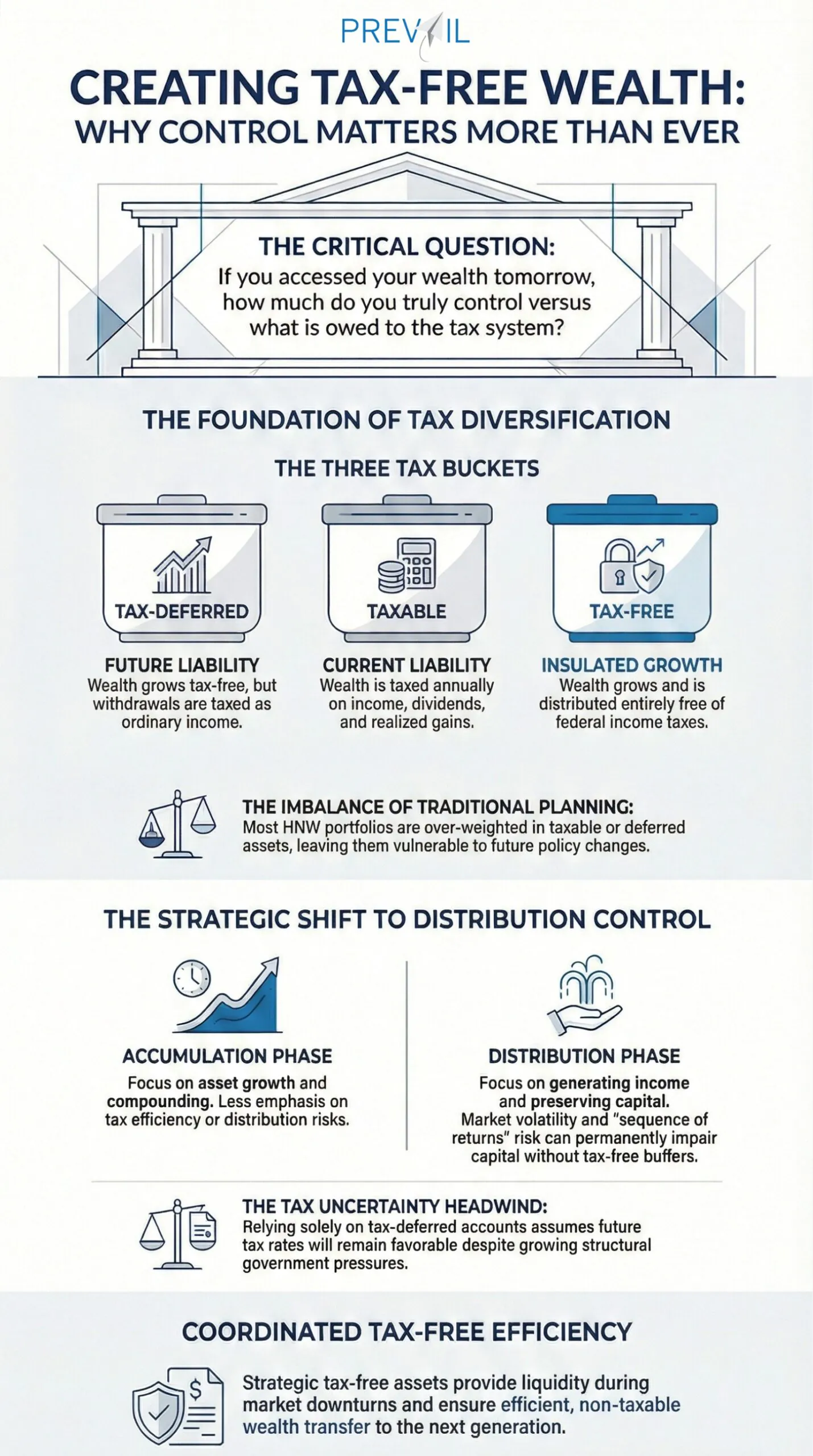
For many high-income earners, the majority of wealth sits in the first two categories.
The tax-free portion is often underrepresented, not due to a lack of awareness, but because traditional tax-free vehicles come with income limits, contribution caps, or narrow use cases.
Without sufficient tax-free capital, business owners may find themselves with significant net worth on paper, but limited flexibility when it comes time to draw income, fund opportunities, or transfer wealth efficiently.
Control Becomes Critical in the Distribution Phase
Accumulating wealth is one challenge. Distributing it efficiently is another.
During working years, market volatility may feel tolerable. Over time, however, the sequence and timing of withdrawals can materially impact outcomes.
Drawing income from market-based assets during periods of decline can permanently impair capital, even if long-term averages appear favorable.
This is why many sophisticated strategies emphasize building sources of capital that are not directly tied to market movement and are not exposed to unpredictable future tax rates.
Having multiple places to source income provides optionality and reduces pressure to make decisions based solely on short-term market conditions.
The Role of Tax-Free Strategies in a Modern Portfolio
Tax-free strategies are not about eliminating taxes entirely or avoiding responsibility. They are about creating balance.
For business owners and family offices, this often means integrating tax-free assets alongside traditional investments and alternative strategies.
Properly structured, certain solutions can provide:
- Access to capital without triggering taxable events
- Flexibility during market downturns
- Greater certainty when planning future income
- More efficient wealth transfer to the next generation
These strategies must be implemented carefully and thoughtfully. They are not designed to replace all other planning tools, nor are they appropriate for every situation.
Instead, they function as one component of a broader, coordinated plan.
Why the Future Tax Environment Matters
While no one can predict future tax policy with certainty, structural realities suggest continued pressure on government revenue.
Long-term obligations, demographic shifts, and ongoing public expenditures create incentives for policymakers to adjust tax systems over time.
For business owners, the implication is not fear, but preparation.
Relying exclusively on tax-deferred accounts assumes future conditions will be favorable.
A more resilient approach acknowledges uncertainty and builds flexibility into the plan.
This is particularly relevant when considering legacy planning. Changes to inherited account rules have increased the likelihood that heirs will face accelerated taxation during their highest earning years.
Without intentional planning and strategic insurance solutions, wealth meant to support future generations may be significantly diluted.
How Prevail Approaches Tax-Free Wealth Planning
At Prevail, we view tax-free wealth as part of a broader philosophy centered on control, coordination, and preparedness.
Our role is not to promote one solution, but to help business owners understand how different components of their balance sheet work together.
We focus on:
- Aligning tax strategy with long-term goals
- Coordinating investment, insurance, and alternative assets
- Reducing reliance on any single source of income or liquidity
- Preparing clients for a wide range of economic environments
This approach is particularly valuable for business owners who think beyond traditional financial planning and want strategies that evolve alongside their businesses, families, and priorities.
A Steady Partner Through Every Financial Cycle
Tax-free wealth is not built overnight. It is created through deliberate planning, disciplined execution, and regular review.
Markets will rise and fall. Policies will change. Life will evolve.
What matters most is having a strategy designed to adapt.
For business owners and high-net-worth families, the cost of doing nothing is often greater than the cost of thoughtful action.
Exploring tax-free strategies today may provide clarity, confidence, and flexibility tomorrow.
At Prevail, we help clients navigate these decisions with care and perspective, serving as a steady advisory partner through every financial cycle.
Learn more about our Tax-Free strategies: https://prevailiws.com/tax-free-strategies/
Frequently Asked Questions
A: Tax-free wealth refers to assets structured so that future growth and access are insulated from federal and, in many cases, state income taxes. For business owners, this can create greater certainty when planning distributions, reinvestment, or legacy transfers, especially in an environment where future tax rates are unknown.
A: Deferring taxes can be helpful in the accumulation phase, but it shifts the tax obligation into the future rather than eliminating it. Without tax diversification, business owners may find that a large portion of their wealth remains exposed to future tax rate changes at the exact time they need income the most.
A: Not necessarily. While tax-free strategies are often associated with retirement planning, many business owners benefit from implementing them earlier. Building tax-free capital over time can improve flexibility during market volatility, business transitions, or unexpected liquidity needs.
A: Prevail approaches tax-free planning as part of a coordinated wealth strategy. Rather than focusing on individual products, we help business owners assess how tax-free assets, investments, and risk management tools work together to support long-term control, adaptability, and financial clarity across different market cycles.