
Markets bucked and sold off again.
Should we be worried?
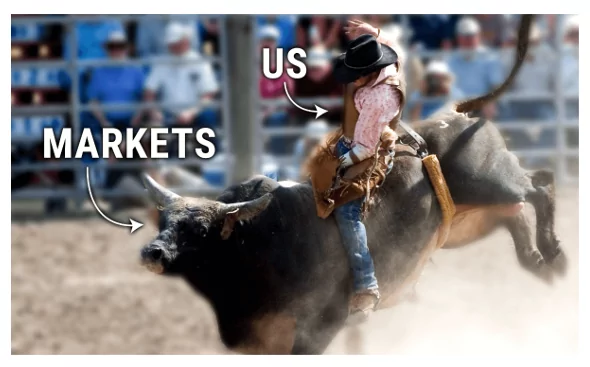 Not necessarily. These things happened pretty regularly, especially when headlines are negative.
In fact, you may recall that we kicked off 2022 with a big drop.
So, let’s talk about what is behind the latest wild market ride.
What led to the selloff?
Primarily, economic worries.
Worries about new COVID surges.
Worries about the U.S. economy.
Worries about international politics.
A report just came out showing the economy shrank by 1.4% in the first three months pf 2022, surprising analysts who expected 1.0% of positive growth.
Though a single quarter of negative growth isn’t a recession, it is a sign that inflation and the pandemic hangover are weighing on the economy.
Realistically, some form of slowdown was probably inevitable, given the massive economic recovery of 2021.
And, the news isn’t all gloom. 1) This is a preliminary report, so we will see more revisions later. 2) Economists still believe the economy has plenty of room to grow, particularly given the strength of the job market, so the economy could rebound. 3) Americans are continuing to spend.
The economy is still strong, but it is showing cracks. We are watching closely.
You can see a theme: markets are being driven by worry and fear.
Is the selling done?
That is impossible to say.
Could we see a bigger correction or bear market?
Absolutely that is possible.
Corrections and pullbacks happen frequently.
Here is a chart that shows intra-year dips in the S&P 500 alongside annual performance. (You’ve probably seen this chart before.)
Not necessarily. These things happened pretty regularly, especially when headlines are negative.
In fact, you may recall that we kicked off 2022 with a big drop.
So, let’s talk about what is behind the latest wild market ride.
What led to the selloff?
Primarily, economic worries.
Worries about new COVID surges.
Worries about the U.S. economy.
Worries about international politics.
A report just came out showing the economy shrank by 1.4% in the first three months pf 2022, surprising analysts who expected 1.0% of positive growth.
Though a single quarter of negative growth isn’t a recession, it is a sign that inflation and the pandemic hangover are weighing on the economy.
Realistically, some form of slowdown was probably inevitable, given the massive economic recovery of 2021.
And, the news isn’t all gloom. 1) This is a preliminary report, so we will see more revisions later. 2) Economists still believe the economy has plenty of room to grow, particularly given the strength of the job market, so the economy could rebound. 3) Americans are continuing to spend.
The economy is still strong, but it is showing cracks. We are watching closely.
You can see a theme: markets are being driven by worry and fear.
Is the selling done?
That is impossible to say.
Could we see a bigger correction or bear market?
Absolutely that is possible.
Corrections and pullbacks happen frequently.
Here is a chart that shows intra-year dips in the S&P 500 alongside annual performance. (You’ve probably seen this chart before.)
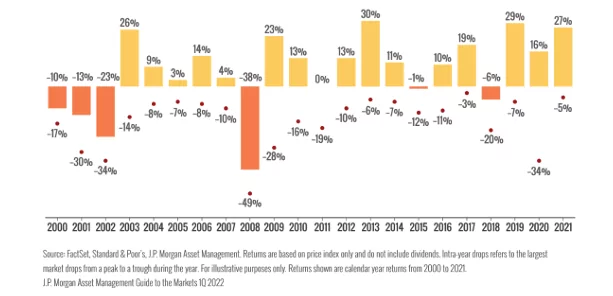 Take a look at the red circle to see the market drops each year.
The big takeaway? In 1 of the last 22 years markets have dropped at least 10%.
We are dealing with a lot of uncertainty in 2022 and investors are feeling very cautious about the future.
However, that doesn’t mean that we should hit the panic button and exit our strategies.
Knee-jerk reactions to market turbulence can be VERY costly.
We are here, watching the situation closely, and will reach out to you directly is we need to make some changes.
Questions? Concerns? Please reply to this email and we will get back to you within 24 hours.
Thanking Calm Thoughts,
Your Prevail Family
1 – https://www.cnbc.com/2022/04/25/stock-market-futures-open-to-close-news.html
2 – https://www.cnbc.com/2022/01/23/stock-market-futures-open-to-close-news.html
3 – https://www.cnbc.com/2022/04/28/us-q1-gdp-growth.html
4 – https://www.washingtonpost.com/business/2022/04/28/gdp-2022-q1-economy/
Archived PDF link
5 – https://am.jpmorgan.com/content/dam/jpm-am-aem/global/en/insights/market-insights/guide-to-the-markets/mi-guide-to-the-markets-us.pdf
Take a look at the red circle to see the market drops each year.
The big takeaway? In 1 of the last 22 years markets have dropped at least 10%.
We are dealing with a lot of uncertainty in 2022 and investors are feeling very cautious about the future.
However, that doesn’t mean that we should hit the panic button and exit our strategies.
Knee-jerk reactions to market turbulence can be VERY costly.
We are here, watching the situation closely, and will reach out to you directly is we need to make some changes.
Questions? Concerns? Please reply to this email and we will get back to you within 24 hours.
Thanking Calm Thoughts,
Your Prevail Family
1 – https://www.cnbc.com/2022/04/25/stock-market-futures-open-to-close-news.html
2 – https://www.cnbc.com/2022/01/23/stock-market-futures-open-to-close-news.html
3 – https://www.cnbc.com/2022/04/28/us-q1-gdp-growth.html
4 – https://www.washingtonpost.com/business/2022/04/28/gdp-2022-q1-economy/
Archived PDF link
5 – https://am.jpmorgan.com/content/dam/jpm-am-aem/global/en/insights/market-insights/guide-to-the-markets/mi-guide-to-the-markets-us.pdf
Not necessarily. These things happened pretty regularly, especially when headlines are negative.
In fact, you may recall that we kicked off 2022 with a big drop.
So, let’s talk about what is behind the latest wild market ride.
What led to the selloff?
Primarily, economic worries.
Worries about new COVID surges.
Worries about the U.S. economy.
Worries about international politics.
A report just came out showing the economy shrank by 1.4% in the first three months pf 2022, surprising analysts who expected 1.0% of positive growth.
Though a single quarter of negative growth isn’t a recession, it is a sign that inflation and the pandemic hangover are weighing on the economy.
Realistically, some form of slowdown was probably inevitable, given the massive economic recovery of 2021.
And, the news isn’t all gloom. 1) This is a preliminary report, so we will see more revisions later. 2) Economists still believe the economy has plenty of room to grow, particularly given the strength of the job market, so the economy could rebound. 3) Americans are continuing to spend.
The economy is still strong, but it is showing cracks. We are watching closely.
You can see a theme: markets are being driven by worry and fear.
Is the selling done?
That is impossible to say.
Could we see a bigger correction or bear market?
Absolutely that is possible.
Corrections and pullbacks happen frequently.
Here is a chart that shows intra-year dips in the S&P 500 alongside annual performance. (You’ve probably seen this chart before.)
Take a look at the red circle to see the market drops each year.
The big takeaway? In 1 of the last 22 years markets have dropped at least 10%.
We are dealing with a lot of uncertainty in 2022 and investors are feeling very cautious about the future.
However, that doesn’t mean that we should hit the panic button and exit our strategies.
Knee-jerk reactions to market turbulence can be VERY costly.
We are here, watching the situation closely, and will reach out to you directly is we need to make some changes.
Questions? Concerns? Please reply to this email and we will get back to you within 24 hours.
Thanking Calm Thoughts,
Your Prevail Family
1 – https://www.cnbc.com/2022/04/25/stock-market-futures-open-to-close-news.html
2 – https://www.cnbc.com/2022/01/23/stock-market-futures-open-to-close-news.html
3 – https://www.cnbc.com/2022/04/28/us-q1-gdp-growth.html
4 – https://www.washingtonpost.com/business/2022/04/28/gdp-2022-q1-economy/
Archived PDF link
5 – https://am.jpmorgan.com/content/dam/jpm-am-aem/global/en/insights/market-insights/guide-to-the-markets/mi-guide-to-the-markets-us.pdf